Schools Harnessing Collaborative Expertise
Some schools are moving in a different direction.
We wanted to understand why.
Across three districts and ten schools, we found different students, different communities, and different circumstances.
What interested us was what kept appearing again.
The Investigations
Are schools that improve actually doing similar things?
Exhibit 01
Documented Investigation
Heatly School
Green Island UFSD · New York
Improvement is possible in a high-needs setting.
One building. Pre-K through grade 12. High need, small staff.
Field notes
- Collaborative time appeared on the master calendar before anything else was scheduled.
- Learning intentions were posted and students restated them when asked.
- Teams reviewed the same student work on a weekly cycle rather than by request.
- Staff described instructional decisions using the same shared language across grade levels.
Exhibit 02
District-Scale Investigation
Billings Public Schools
Billings, Montana · Eight corroborating school sites
The same practices hold across an entire district, not one building.
A district implementation observed across multiple schools over successive visits.
Field notes
- One set of district priorities was repeated without local rewording.
- Leaders entered classrooms on a published schedule rather than by exception.
- Prior initiatives were formally ended before new ones began.
- Implementation was routinely monitored rather than assumed.
Corroborating investigations within the district
Arrowhead
Success criteria written before instruction and referenced during it.
Rose Park
Teachers compared student evidence in team meetings rather than describing activities.
Will James
Feedback to students named the next step instead of scoring the last one.
Lewis & Clark
The same instructional language appeared in three unrelated classrooms.
Castle Rock
Team time was protected on the calendar and used for reviewing student work.
Senior High
Departments named a single shared priority and could state it independently.
Eagle Cliffs
Students could say what they were learning and what success looked like.
Alkali Creek
Students independently described what they would do next when work was not yet correct, without waiting for the teacher to direct them.
Eight schools. One district. The same instructional behaviors recorded at each site.
Exhibit 03
Corroborating Investigation
FASNY
French-American School of New York
The same practices transfer to an entirely different educational setting.
An independent, bilingual school — different students, funding, and governance.
Field notes
- Teachers across two languages of instruction described learning intentions in the same terms.
- Team meetings began with student work rather than announcements.
- Adults compared evidence before deciding what to change next.
- Fewer priorities were carried, and they were carried across full years.
What kept appearing
A turnaround school. A whole district. An independent bilingual school.
- Protected collaborative time
- Clarity about what students are learning
- Evidence reviewed together
- Fewer priorities, held longer
- Implementation actually monitored
Coherence
Belonging
Consistency
Different places. Different circumstances. Recurring conditions.
The work behind the work
We gave what we kept seeing a name.
Across schools and systems, the same conditions kept appearing: greater coherence around what mattered, stronger belonging through genuine educator empowerment, and greater consistency in the adult actions students experienced.
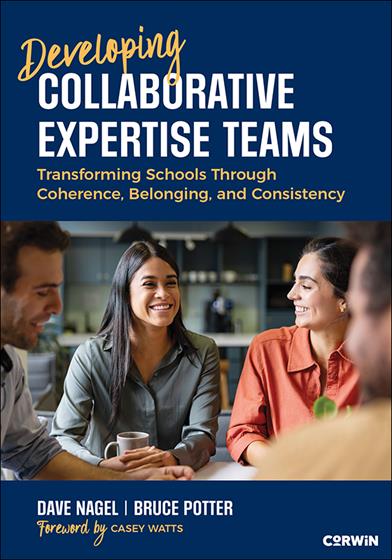
Those observations — alongside the research and our work with educators — became Developing Collaborative Expertise Teams: Transforming Schools Through Coherence, Belonging, and Consistency.
Dave Nagel & Bruce Potter
Corwin · 2026
The point isn't to become one of these schools.
It's to understand what makes improvement possible in yours.
What story is your school living?